What Does a QA Engineer Do? Role, Skills and Career Path
What does a QA engineer actually do every day? The real responsibilities, key skills, QA vs SDET differences, and the career path from junior to lead.
Ask ten people what a QA engineer does and you will hear ten answers, from "clicks buttons to find bugs" to "writes automation code all day". Both are incomplete, and that confusion stops many talented people from entering one of the most accessible and versatile careers in tech.
This guide explains what a QA engineer really does, the skills the role requires in 2026, how it differs from related roles, and how the career path develops from your first job to senior and leadership positions.
What is a QA engineer?
A QA engineer, or quality assurance engineer, is responsible for making sure software meets requirements, works reliably and provides a good experience to users. They do this by preventing defects early in development, testing the product manually and through automation, and giving the team clear information about quality and risk so it can make good release decisions.
The key idea is that QA is not only about finding bugs. It is about reducing the risk of releasing software that hurts users or the business.
What a QA engineer does day to day
A typical week usually includes a mix of these activities.
- Reviewing requirements. Joining refinement sessions, asking questions, spotting gaps and helping define acceptance criteria before code is written.
- Planning tests. Deciding what to test, how, and what the risks are for each feature or release.
- Designing test cases. Writing clear, reusable checks using techniques such as boundary value analysis. See how to write test cases.
- Exploratory testing. Investigating new features to find problems scripts would miss, as described in our exploratory testing guide.
- Testing APIs. Checking business logic directly, often before the UI exists.
- Writing and maintaining automation. Building UI and API tests that run in the CI/CD pipeline.
- Reporting bugs. Writing clear defect reports and helping developers reproduce issues.
- Retesting and regression testing. Confirming fixes and making sure nothing else broke.
- Communicating quality. Sharing test results, risks and recommendations with developers, product owners and managers.
The balance between manual and automated work depends on the company, the product and your seniority.
QA engineer vs related roles
Job titles in testing vary between companies. This table shows the most common distinctions.
| Role | Main focus | Coding level |
|---|---|---|
| Manual tester / QA tester | Executing tests, exploratory testing, bug reporting | Low |
| QA engineer | Test strategy, manual and automated testing, quality process | Low to medium |
| QA automation engineer | Building and maintaining automated test suites | Medium to high |
| SDET (Software Development Engineer in Test) | Test frameworks, tools and testability, often working inside the codebase | High |
| QA lead / test manager | Planning, coordinating testers, quality reporting, process improvement | Varies |
| Performance or security tester | Specialised non-functional testing | Medium to high |
In many modern teams the boundaries are blurred, and a QA engineer is expected to combine strong testing skills with at least some automation.
Skills a QA engineer needs in 2026
Testing fundamentals. Test design techniques, test types, the bug life cycle and risk-based testing. Our article on smoke vs sanity vs regression testing is a good place to check your foundations.
Bug reporting and defect management. Writing reports developers act on and understanding bug severity vs priority.
API testing. HTTP methods, status codes, Postman and basic API automation.
Test automation. One programming language such as Python, Java or JavaScript, plus a tool such as Playwright or Selenium. Read our honest comparison of Playwright vs Selenium.
CI/CD and DevOps basics. Git, pipelines and how automated tests fit into delivery.
Databases. Basic SQL to verify data and prepare test data.
Soft skills. Clear writing, curiosity, attention to detail, diplomacy when reporting problems, and the confidence to raise risks early.
Soft skills are often what separates good testers from great ones. A QA engineer who can explain a risk clearly to a product manager has more impact than one who finds twice as many bugs but cannot get them prioritised.
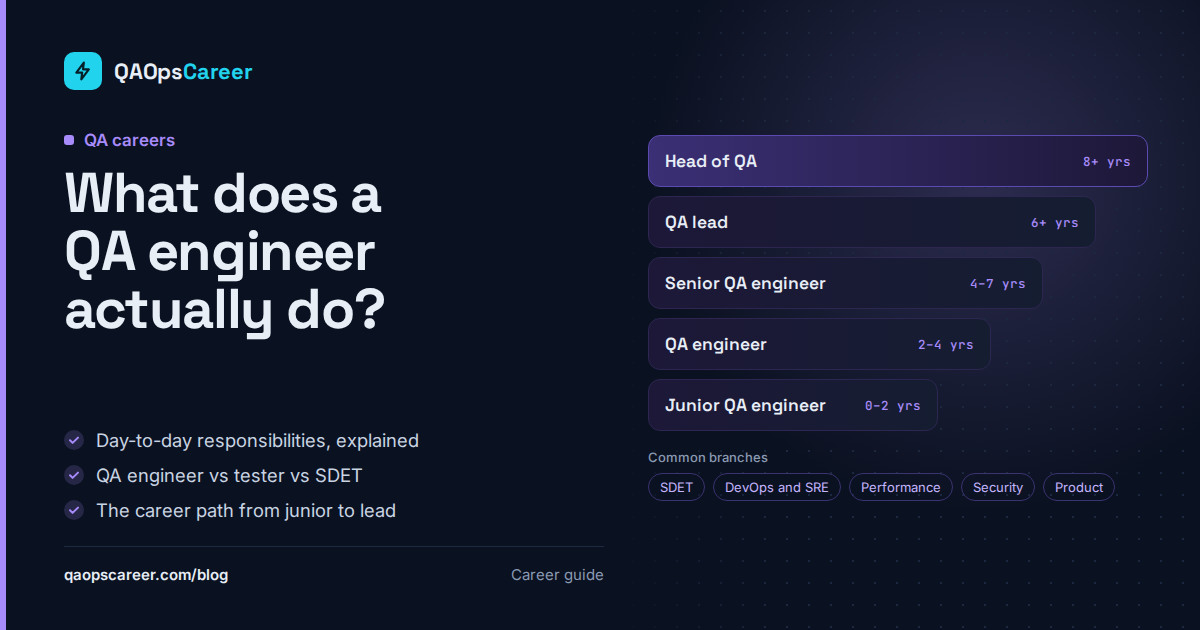
The QA career path
| Level | Typical experience | Main responsibilities |
|---|---|---|
| Junior QA engineer | 0 to 2 years | Executing test cases, exploratory testing, bug reporting, learning automation |
| QA engineer | 2 to 4 years | Designing tests independently, owning features, writing automation |
| Senior QA engineer | 4 to 7 years | Test strategy, framework design, mentoring, influencing quality across teams |
| QA lead or test manager | 6+ years | Planning, coordinating teams, metrics, process improvement |
| Head of QA or quality engineering manager | 8+ years | Quality strategy across the organisation, hiring, budgets |
These ranges are typical, not rules. Progress depends on skills and impact, not years alone.
Many QA engineers also branch into related careers, using their testing background as a strength. Common paths include SDET and software development, DevOps and site reliability engineering, performance engineering, security testing, product management and business analysis. Understanding how systems fail, which is what testers learn every day, is valuable in all of these roles.
Is QA a good career in 2026?
Yes, for people who enjoy problem solving, learning how systems work and improving products. Software keeps growing in complexity and in impact on daily life, and teams still need people who think critically about risk.
The role is changing, though. AI-assisted tools now help generate test ideas, test data and automation code, and teams increasingly expect QA engineers to use them well. That makes judgement more valuable, not less: someone still needs to decide what matters, check whether generated tests are meaningful and understand what the results really say. Testers who combine strong fundamentals with automation and good use of modern tools are well positioned.
How to become a QA engineer
- Learn testing fundamentals. Test design, test types, bug reporting and the testing life cycle.
- Practise on real applications. Test public demo sites and write test cases and bug reports for them.
- Learn API testing. Start with Postman, as explained in API testing for beginners.
- Learn one programming language and one automation tool. Follow our manual to automation testing roadmap.
- Build a portfolio. Publish test cases, bug reports and an automation project on GitHub.
- Prepare for interviews. Review our QA interview questions and answers.
Do you need a degree to become a QA engineer?
No. Many QA engineers come from other careers, such as customer support, teaching, finance or administration. Employers mainly look for testing knowledge, practical evidence such as a portfolio, and the ability to learn. A computer science degree helps but is not required.
Do QA engineers need to code?
For entry-level manual testing roles, coding is often not required. For most QA engineer roles in 2026, at least basic coding for automation and API testing is expected, and it significantly improves career growth.
Is QA engineering stressful?
It can be, especially close to releases when deadlines are tight. Teams with clear test plans, automated regression and agreed exit criteria reduce that pressure a lot. Good planning makes release days calm rather than chaotic.
Can QA engineers work remotely?
Yes. Testing is well suited to remote work, because most activities, including manual testing, automation, reporting and collaboration, happen through cloud tools. Many companies hire QA engineers for fully remote or hybrid roles.
Key takeaways
- A QA engineer reduces the risk of releasing poor software, not only by finding bugs.
- The role combines requirement review, test design, manual and automated testing and clear communication.
- Core skills include test design, API testing, automation, CI/CD basics, SQL and strong soft skills.
- The career path leads to senior, lead and management roles, or into SDET, DevOps, performance and security.
- You do not need a degree. You need fundamentals, practice and a portfolio.
Ready to start your QA career with structured training, real projects and mentoring from senior engineers? Explore the QAOpsCareer courses and live training sessions.
- QA engineer
- QA career
- QA engineer skills
- SDET
- software testing careers
- career change