How to Get Your First QA Job With No Experience (2026 Guide)
No experience? Here is a realistic step-by-step plan to land your first QA job in 2026: skills, portfolio, CV, where to apply and how to pass the interview.
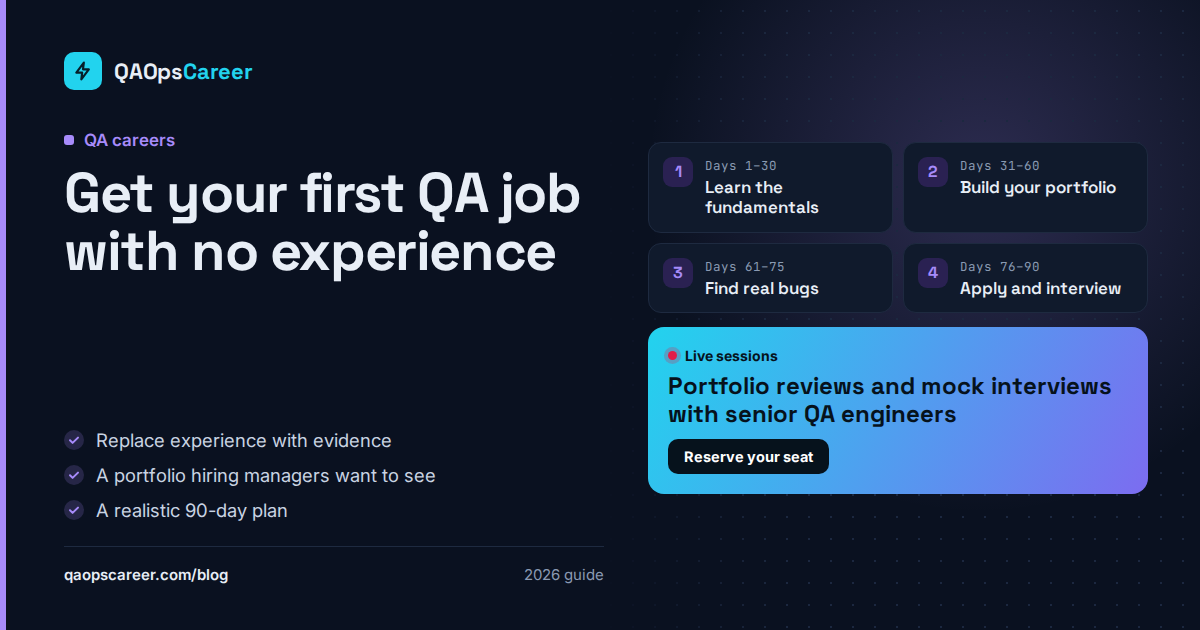
"Entry level, 2 years of experience required." If you have searched for your first QA job, you have seen this contradiction many times. It is frustrating, and it convinces many capable people to give up before they really start.
The truth is that thousands of people get their first QA job every year without previous testing experience. They succeed not because they are lucky, but because they replace experience with evidence. This guide shows you exactly how to do that, step by step.
If you prefer to follow this plan with guidance from senior QA engineers instead of alone, our live training sessions walk you through each step on real projects.
Why QA is one of the best entry points into tech
Software testing is one of the most accessible careers in technology. You do not need a computer science degree, the fundamentals can be learned in a few months, and the skills you build, such as analysing requirements, understanding systems and communicating problems, open doors to automation, DevOps, product and security later.
If you want to understand the role in depth first, read what does a QA engineer do.
What "no experience" really means to employers
When a hiring manager rejects a candidate for lack of experience, they are usually worried about three things: whether you can find real bugs, whether you can communicate them clearly, and whether you can work in a real team process. Your job is to prove all three before your first interview.
Your experience counts more than you think
Many career changers already have skills that QA teams value.
| Previous background | Transferable QA strength |
|---|---|
| Customer support | Understanding real user problems and describing issues clearly |
| Teaching | Explaining complex topics simply and structured thinking |
| Finance and accounting | Attention to detail and data accuracy |
| Retail and hospitality | User empathy and working under pressure |
| Administration | Process discipline and documentation |
| Engineering or science | Analytical thinking and experimentation |
Write these strengths in your CV and connect them to testing. "Handled 50 support tickets a day and documented recurring product issues for the development team" is already QA-relevant experience.
Step 1: learn the fundamentals that interviews test
Focus on the topics that appear in almost every junior interview.
- Test design: test cases, test scenarios, boundary value analysis and equivalence partitioning. Start with how to write test cases.
- Test types: smoke, sanity, regression and retesting, explained in smoke vs sanity vs regression testing.
- Bug reporting and severity versus priority, covered in how to write a bug report engineers act on and bug severity vs priority.
- Exploratory testing, covered in our exploratory testing guide.
- API testing basics with Postman, covered in API testing for beginners.
- Basic SQL to check data, covered in SQL for QA testers.
You do not need to master automation before your first job, but basic knowledge of one tool makes you stand out from other junior candidates.
Step 2: build a portfolio that replaces experience
A portfolio is the single most powerful tool for a candidate without experience. It shows hiring managers real work instead of promises.
A strong junior QA portfolio contains these items.
- A test plan for a public demo application, one or two pages long, following how to write a test plan.
- 20 to 30 well-written test cases covering positive, negative and boundary scenarios.
- 5 to 10 professional bug reports for real issues you found, with screenshots or recordings.
- An exploratory testing session report with a charter, notes and findings.
- A Postman collection with API tests for a public API.
- Optionally, a small automation project on GitHub with a clear README.
Publish everything on GitHub or a simple portfolio page, and add the link at the top of your CV and LinkedIn profile.
Want feedback on your portfolio from engineers who hire testers? Join our next live session, where we review real student work and show exactly what makes hiring managers say yes.
Step 3: get real-world testing experience fast
You can build genuine experience before your first full-time job.
- Crowdtesting platforms. Platforms such as uTest and Test IO pay testers to find bugs in real products. Even a few accepted bug reports are real experience you can list on your CV.
- Open-source projects. Many projects welcome testers who report bugs, verify fixes and improve documentation.
- Freelance and volunteer testing. Small businesses, startups and non-profits often need someone to test their website before launch.
- Internships and trainee programmes. Many companies run QA trainee or graduate programmes with no experience requirement.
Step 4: write a CV that gets past the first screen
Hiring managers spend very little time on each CV. Make every line count.
- Put a short summary at the top: your target role, key skills and portfolio link.
- List testing skills specifically: test case design, exploratory testing, bug reporting, Postman, SQL, Jira, Git.
- Describe projects with outcomes, such as "Found and documented 12 defects in a public e-commerce demo, including 2 critical checkout issues".
- Translate previous jobs into QA strengths using the table above.
- Keep it to one page and use the keywords from the job description.
Step 5: apply smartly, not massively
Sending 200 identical applications rarely works. A focused approach is more effective.
- Search for titles such as Junior QA Engineer, QA Tester, Software Tester, QA Analyst, Test Analyst and QA Trainee.
- Apply to roles where you meet roughly 60 to 70 percent of the requirements. Job descriptions are often wish lists.
- Personalise the first lines of each application with something about the company's product.
- Test the company's website or app briefly and mention one constructive observation in your cover letter. This shows initiative immediately.
- Connect with QA engineers and QA leads on LinkedIn, share what you are learning, and ask thoughtful questions rather than asking for jobs directly.
Step 6: prepare for the interview
Junior QA interviews usually combine theory questions, a practical task and behavioural questions. Expect requests such as "how would you test a login page" or "write test cases for this feature". Our list of QA interview questions and answers covers the most common ones with model answers.
Practise answering out loud, prepare examples from your portfolio for every topic, and be ready to explain why you want to work in QA.
A realistic 90-day plan
| Period | Focus | Result |
|---|---|---|
| Days 1 to 30 | Fundamentals: test design, test types, bug reporting | Write test cases and bug reports confidently |
| Days 31 to 60 | Portfolio: test plan, test cases, bug reports, Postman, SQL | A public portfolio link |
| Days 61 to 75 | Real experience: crowdtesting, open source, volunteer testing | Real bugs and projects on your CV |
| Days 76 to 90 | CV, LinkedIn, applications and interview practice | Targeted applications and interview readiness |
With one to two hours a day, this plan is achievable alongside a full-time job. Many people speed it up significantly with structured training, regular feedback and mock interviews.
Common mistakes that keep beginners stuck
- Endless tutorials without practice. Watching videos feels productive but builds no evidence.
- Waiting to feel ready. Start applying once your portfolio has real work in it.
- A generic CV. "Detail-oriented team player" says nothing. Show results.
- Learning automation before fundamentals. Weak test design makes automation useless.
- Studying alone without feedback. You cannot see your own blind spots, and small mistakes repeat in every application.
Can I get a QA job without a degree?
Yes. Many QA engineers are self-taught or come from other careers. Employers mainly look for testing knowledge, a portfolio and good communication.
Do I need ISTQB certification for my first QA job?
It is not required for most roles, but the ISTQB Foundation Level certificate can help, especially in Europe and in large organisations. A strong portfolio usually carries more weight than a certificate alone.
How long does it take to get a first QA job?
It depends on your time, your market and your preparation. Many people with focused daily practice and a strong portfolio get their first offer within three to six months.
Is manual testing still a good way to start in 2026?
Yes. Manual testing fundamentals are the foundation of every QA role. Most employers expect juniors to grow into automation over time, which you can plan with our manual to automation testing roadmap.
Key takeaways
- Replace missing experience with evidence: a portfolio, real bugs and clear communication.
- Learn the fundamentals interviews actually test.
- Gain real experience through crowdtesting, open source and volunteer projects.
- Write an outcome-focused CV and apply in a targeted way.
- Get feedback early instead of studying alone.
Get your first QA job faster with live mentoring
Reading a guide is the first step. Doing the work with expert feedback is what gets you hired.
In our live training sessions, senior QA engineers guide you through real testing projects, review your test cases and bug reports, help you build a portfolio that stands out, and run mock interviews based on what hiring managers actually ask. You learn alongside other motivated career changers, ask your questions in real time and leave each session with practical work for your portfolio.
Reserve your seat in the next live session and start your QA career with a clear plan and people in your corner.
- QA jobs
- entry level QA
- QA career
- career change
- QA portfolio
- software testing